
Buyer's Desk
Refurbished MRI Scanner Buying Guide: Field Strength, Open vs. Closed, and What It Really Costs
March 26, 2026 · 6 min · Medical Imaging Specialists
Practical considerations, risk points, and what to ask before you buy, service, move, or maintain imaging equipment.
Meta Title: Refurbished MRI Scanner Buying Guide | Field Strength, Cost & More | MIS Meta Description: Buying a refurbished MRI scanner? Learn how to choose the right field strength, open vs. closed bore, and what a refurbished MRI really costs. Expert guidance from Medical Imaging Specialists.
MRI is one of the most powerful diagnostic tools in medicine — and one of the most expensive capital purchases a facility will make. For hospitals, outpatient imaging centers, and specialty clinics trying to stretch their budgets, a refurbished MRI scanner can deliver the same clinical performance as new equipment at a fraction of the price.
But the MRI market is complex. Field strengths, bore sizes, open configurations, gradient performance, software versions — there’s a lot to sort through before you sign a purchase order. This guide breaks it down so you can buy with confidence.
Why Choose a Refurbished MRI?
New MRI systems from GE, Siemens, and Philips can run anywhere from $1 million to over $3 million, fully installed. A properly refurbished system from a reputable vendor can cost 40–70% less — often $300,000 to $1.2 million depending on the configuration — without sacrificing image quality or reliability.
The key phrase is properly refurbished. A good refurbishment means the system has been inspected, repaired, and tested to OEM specifications, with parts replaced as needed and the software updated to a stable, supported version. Not all refurbished MRI vendors do this at the same level. That’s where due diligence matters.
Understanding MRI Field Strength: 1.5T vs. 3T
Field strength is measured in Tesla (T) and is one of the most important specs to evaluate. It directly affects image resolution, scan speed, and clinical application range.
1.5T MRI
The 1.5T is the workhorse of clinical MRI. It handles the vast majority of routine diagnostic imaging — brain, spine, extremities, abdomen, MSK, cardiac screening. For most outpatient centers and community hospitals, 1.5T is the right call.
Refurbished 1.5T systems are widely available from GE, Siemens, and Philips, often in configurations from 2012 onward. Parts availability is excellent, service costs are manageable, and the installed base is huge.
Best for: General outpatient imaging, community hospitals, rural facilities, clinics starting their MRI program
3T MRI
Three Tesla systems provide twice the signal-to-noise ratio of 1.5T, enabling faster scans, thinner slices, and superior soft tissue contrast. They’re essential for advanced neuroimaging, research applications, prostate MRI, and high-resolution cardiac studies.
The trade-off: 3T systems are more expensive to purchase, install, and service. They require stronger, more precise shielding and are more sensitive to patient motion artifacts. They also typically have a higher demand for helium cooling.
Best for: Academic medical centers, neurology specialists, radiology practices with high volume advanced imaging protocols
Bottom line: Don’t over-buy on field strength. A 1.5T system that’s well-maintained and properly configured will outperform a 3T that’s undersupported. Match the system to your actual clinical volume and case mix.
Open vs. Closed Bore MRI
Closed Bore (Cylindrical) MRI
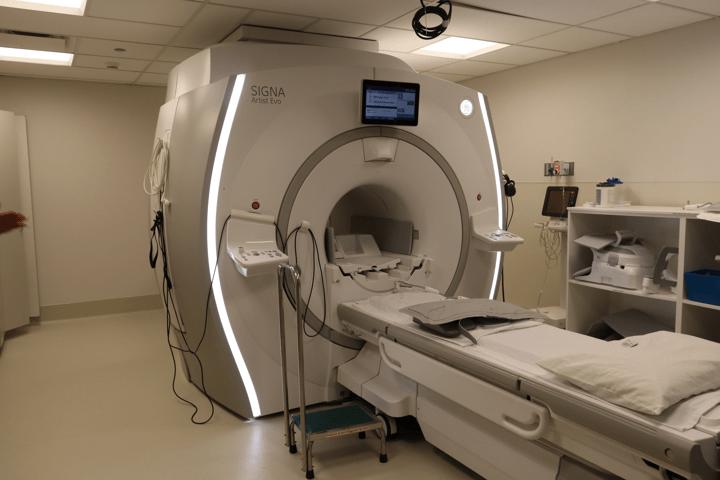
Traditional closed bore systems have a cylindrical magnet tunnel, typically 60–70 cm in diameter. They offer the strongest field strengths and the best image quality available in clinical MRI. Modern wide-bore systems (70 cm) have significantly reduced claustrophobia rates compared to older 60 cm designs.
The vast majority of refurbished MRI systems on the market are closed bore 1.5T or 3T units. If clinical performance is the priority, this is the category to shop in.
Open MRI
Open MRI systems use a gap between two magnet poles, allowing patients to sit or stand during imaging and accommodating bariatric patients more easily. They’re also well-suited for pediatric imaging and patients with severe claustrophobia.
The trade-off is field strength — most open MRI systems top out at 0.7T to 1.0T, which limits image resolution and scan speed. Interventional open MRI systems can go higher, but they command a significant price premium.
Best for: Facilities with high bariatric volume, orthopedic practices doing weight-bearing imaging, markets where patient comfort is a competitive differentiator
Key Specs to Evaluate Beyond Field Strength
When reviewing refurbished MRI options, don’t stop at field strength. These additional specs will shape your daily workflow:
- Gradient performance (mT/m and slew rate): Higher gradients = faster imaging and better diffusion imaging capability. Look for systems with at least 33 mT/m amplitude for general clinical use.
- Bore diameter: 70 cm wide-bore designs are strongly preferred for patient comfort and throughput.
- Software version: Confirm the software version is still supported and whether upgrades are available. Obsolete software can limit your protocol options.
- Coil inventory: RF coils are expensive. Confirm which coils are included and whether they’re current-generation. Missing or worn coils are a hidden cost in many transactions.
- Magnet helium level and quench history: Ask for documentation on the current helium level and whether the magnet has ever quenched (a full loss of superconductivity). A quench history isn’t necessarily a dealbreaker, but it needs to be disclosed and explained.
- Chiller/cooling system age: The cooling system is a significant maintenance item. Ask about its age and service history separately from the magnet itself.
What Does a Refurbished MRI Actually Cost?
Here’s a realistic breakdown of what to budget:
| Configuration | Estimated Equipment Cost | Notes |
|---|---|---|
| Refurbished 1.5T closed bore | $300K – $700K | Wide range by model year and vendor |
| Refurbished 3T closed bore | $500K – $1.2M | Strong demand; less availability |
| Refurbished open 1.0T | $150K – $400K | Limited vendors; part availability varies |
Installation adds cost. Site preparation, magnet ramping, RF shielding, and installation labor can add $150,000–$400,000 depending on your facility and whether a new magnet room needs to be built.
Service contracts matter. Budget $60,000–$120,000 per year for a full-service contract on a 1.5T, depending on the OEM and vendor. A Time & Materials arrangement can cost less upfront but leaves you exposed to large unplanned repair bills.
Questions to Ask Your Vendor Before Buying
- What is the magnet’s serial number, and can you provide its full service history?
- Has the system been de-installed, and how was it transported and stored?
- What is the current helium level, and has the magnet quenched?
- What software version does it carry, and what upgrades are available?
- What coils are included, and are they in operational condition?
- Who will perform the installation, and do they have OEM-certified engineers?
- What warranty do you provide, and what does it cover?
A credible vendor will answer these questions without hesitation. Vague answers or missing documentation are red flags.
Work with a Vendor Who Knows MRI Inside and Out
Buying a refurbished MRI is not like buying a used car. The complexity of the equipment, the cost of installation, and the long-term service commitment mean your vendor relationship matters as much as the machine itself.
Medical Imaging Specialists has been buying, refurbishing, and supporting MRI systems — along with CT and PET/CT — since 2004. Based in Bradenton, Florida, we serve clients across the United States, the Caribbean, and Latin America. Our in-house engineers, parts inventory, and hands-on service capabilities mean we stand behind every system we sell.
If you’re evaluating a refurbished MRI purchase or just trying to figure out where to start, reach out to Medical Imaging Specialists. We’ll give you straight answers and help you find the right system for your clinical and financial goals.
Contact MIS: medicalimaging.com | Call or email us for a no-pressure consultation.
Medical Imaging Specialists | Bradenton, Florida | Serving the US, Caribbean & LATAM since 2004
Related Reading
- Read next: 1 5T Vs 3T Refurbished Mri Field Strength Guide
- Read next: Mri Site Planning Rf Shielding Cryogen Requirements
Talk Through Your Next Imaging Project
If you are evaluating refurbished imaging equipment, planning a service strategy, or trying to keep an aging scanner productive, Medical Imaging Specialists can help. Contact MIS through the website and tell us what system you are working with.
Need help with this exact problem?
Send the modality, site location, timeline, and any system details. MIS will route the request by intent.
Related resources
Buyer's Desk
What Is a Fair Price for Used X-Ray Equipment?
A fair used X-ray equipment price depends on scope, detector condition, site readiness, installation, service, parts, and support.
Buyer's Desk
How Much Does Used Medical Imaging Equipment Cost?
Used medical imaging equipment cost depends on modality, model, condition, site work, installation, service, parts, and support scope.
Buyer's Desk
Best Used MRI for an Outpatient Imaging Center
Choose the right used MRI for an outpatient center by matching field strength, bore size, coils, site needs, service, and volume.