
Buyer's Desk
Open MRI vs. Closed Bore MRI: Which Is Right for Your Facility?
April 6, 2026 · 6 min · Medical Imaging Specialists
Practical considerations, risk points, and what to ask before you buy, service, move, or maintain imaging equipment.
When a facility is shopping for a refurbished MRI system, one of the first forks in the road is this: open or closed bore? It sounds like a simple choice, but the implications touch everything — patient throughput, image quality, your referral base, and your total capital outlay. Getting this decision wrong can mean underutilizing a $500,000 piece of equipment or losing referring physicians because your image quality doesn’t meet their diagnostic standards.
This guide breaks down the real differences between open and closed bore MRI systems so you can make a confident, informed decision.
What Is a Closed Bore MRI?
A closed bore MRI — the traditional cylindrical tunnel-style scanner — is the workhorse of diagnostic imaging. The patient lies on a table that slides into a horizontal tube, typically 60–70 cm in diameter. Most closed bore systems operate at 1.5 Tesla (T) or 3T field strengths, which is why they dominate in hospitals, imaging centers, and academic medical settings.
Key advantages:
- Superior signal-to-noise ratio (SNR) for higher image quality
- Faster scan times due to stronger magnetic fields
- Broader application coverage — brain, spine, cardiac, oncology, MSK, vascular
- Wider acceptance by radiologists and referring physicians
- More models available in the refurbished market
Limitations:
- Bore diameter (60–70 cm) can be uncomfortable or impossible for larger patients or those with claustrophobia
- Louder acoustic environment
- Higher siting requirements (RF shielding, room size, cooling)
What Is an Open MRI?
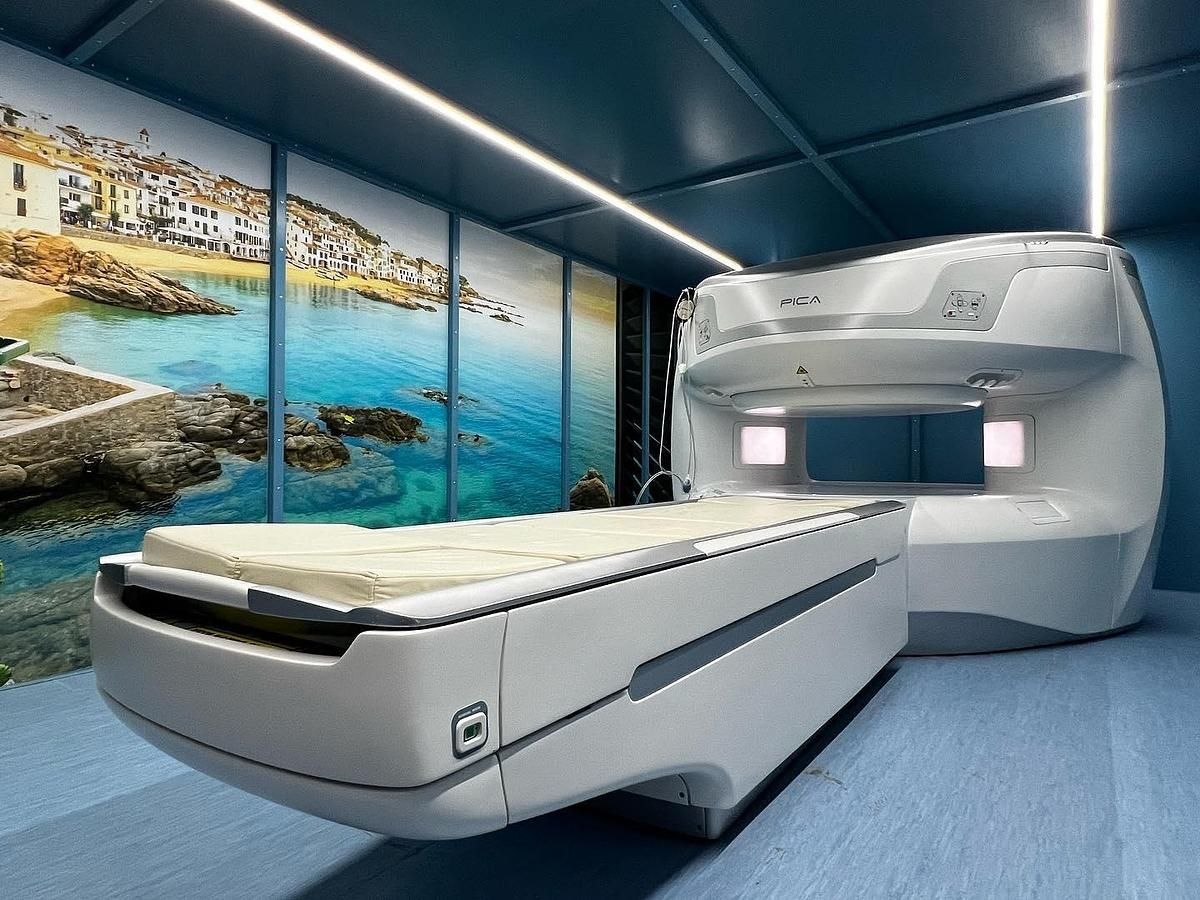
Open MRI systems remove the tunnel entirely. The most common design uses two magnetic poles above and below the patient table, creating an open, airy scanning environment. A less common variant is the wide-bore closed system (70–75 cm diameter), which splits the difference — offering more room without sacrificing as much field strength.
Traditional open MRI systems typically operate at 0.3T to 1.0T, though some high-field open systems reach 1.2T.
Key advantages:
- Patient-friendly for claustrophobic, anxious, bariatric, or pediatric patients
- Quieter operation
- Can scan in alternative positions (weight-bearing, upright) depending on design
- Lower siting and infrastructure requirements in some configurations
- Generally lower acquisition cost
Limitations:
- Lower field strength = lower SNR and longer scan times
- Image quality often insufficient for neurological, oncological, or vascular studies
- Fewer software and coil upgrades available in the aftermarket
- Some referring physicians and radiologists won’t accept open MRI studies for certain protocols
Comparing Image Quality: The Honest Answer
Field strength is the primary driver of image quality, and this is where open MRI systems face their biggest challenge. A 1.5T closed bore system will outperform a 0.7T open MRI in virtually every clinical category. The gap narrows as you move into high-field open systems (1.0T–1.2T), but the tradeoff with scan time and SNR remains.
For facilities focused on orthopedic or extremity imaging, a mid-field open MRI can deliver clinically acceptable images at a fraction of the cost. For facilities doing neuro, oncology, or cardiac work, a 1.5T or 3T closed bore is non-negotiable.
| Factor | Open MRI | Closed Bore MRI |
|---|---|---|
| Typical field strength | 0.3T – 1.2T | 1.5T – 3T |
| Image quality | Good to adequate | Excellent |
| Scan time | Longer | Faster |
| Patient comfort | Higher | Lower |
| Clinical versatility | Moderate | High |
| Refurbished cost range | $150K – $600K | $250K – $1.2M+ |
| Siting complexity | Lower | Higher |
Patient Population: Know Who You’re Scanning
This is often the deciding factor. Ask yourself:
- What percentage of your patients are claustrophobic or anxious? If you routinely lose patients to scan cancellations due to bore anxiety, an open or wide-bore system directly addresses lost revenue.
- What is your patient BMI distribution? A standard 60 cm bore has a practical weight limit around 300–350 lbs. Wide-bore closed systems (70 cm) extend that range significantly.
- Are you serving pediatric patients? Younger children may tolerate an open environment without sedation, which reduces clinical risk and cost.
- What are your referring physicians ordering? If your referrals are predominantly orthopedic joint studies, an open MRI may serve you well. If neurology is a large portion, you’ll need closed bore capability.
Cost Considerations in the Refurbished Market
Refurbished open MRI systems — particularly older 0.7T units from manufacturers like Hitachi, Esaote, or GE — can be acquired for as little as $150,000–$300,000 all-in, including installation. That’s an attractive entry point for smaller clinics or facilities just adding MRI capability.
Refurbished 1.5T closed bore systems from GE, Siemens, or Philips typically run $350,000–$700,000 depending on age, gradient performance, software level, and coil inventory. Well-maintained systems in the 8–12 year range can offer excellent clinical performance at a significant discount over new.
Total cost of ownership factors to weigh:
- Service contracts: Open MRI service tends to be less complex and cheaper; high-field closed bore contracts are a meaningful annual expense
- Helium costs: Superconducting closed bore magnets require liquid helium; open resistive or permanent magnets do not
- Throughput: Faster scan times on closed bore systems mean more patients per day, improving revenue per hour of operation
- Coil inventory: Used coil sets for legacy open systems can be harder to source
Wide-Bore Closed MRI: The Middle Ground
If your facility needs strong image quality and better patient comfort, a wide-bore 1.5T system (70 cm bore, like the GE Optima MR450w or Siemens MAGNETOM Aera) is worth serious consideration. These systems perform at full 1.5T while accommodating larger patients and reducing claustrophobia-related scan failures. In the refurbished market, wide-bore 1.5T systems have become increasingly available as facilities upgrade to 3T.
Which Should You Choose?
Here’s a simple decision framework:
- Choose open MRI if: You’re a smaller orthopedic or general outpatient clinic, your patient volume is moderate, your referrals skew toward MSK imaging, and cost or siting constraints are real factors.
- Choose closed bore 1.5T if: You need broad clinical coverage, your referral base expects diagnostic-grade imaging across specialties, and you want maximum flexibility in the used market for coils, software, and service support.
- Choose closed bore 3T if: You have neurological, research, or oncological imaging demands that require the highest SNR and resolution, and your volume justifies the higher capital and operating costs.
- Choose wide-bore 1.5T if: Patient comfort is a priority but you can’t accept the image quality limitations of open MRI.
Work With a Vendor Who Knows Both Markets
The refurbished MRI market has dozens of models from multiple manufacturers, and what looks like a bargain can become a headache if the coil inventory is incomplete, the magnet is approaching end-of-life, or service support is unavailable in your region.
Medical Imaging Specialists has been buying, refurbishing, and supporting MRI systems since 2004. Our team has hands-on experience with GE, Siemens, and Philips systems — both open and closed bore — and we serve facilities across the U.S., Caribbean, and Latin America. We can help you match the right system to your clinical needs, patient population, and budget, and we back it with in-house service and parts support after the sale.
Ready to talk through your options? Contact Medical Imaging Specialists to speak with someone who’s been doing this for over 20 years.
Medical Imaging Specialists | Bradenton, Florida | Serving the U.S., Caribbean, and Latin America since 2004
Related Reading
- Read next: Refurbished Mri Scanner Buying Guide
- Read next: 1 5T Vs 3T Refurbished Mri Field Strength Guide
Need help with this exact problem?
Send the modality, site location, timeline, and any system details. MIS will route the request by intent.
Related resources
Buyer's Desk
What Affects Used Medical Imaging Equipment Resale Value?
Used imaging equipment resale value depends on model, condition, records, accessories, demand, supportability, and removal complexity.
Buyer's Desk
What Questions Should You Ask Before Buying a Used MRI?
Before buying a used MRI, ask these equipment, service, site, logistics, parts, and quote questions to avoid expensive surprises.
Buyer's Desk
What to Look for When Buying a Used CT Scanner
Buying a used CT scanner? Check tube life, service history, parts support, site fit, software, installation scope, and post-sale service.